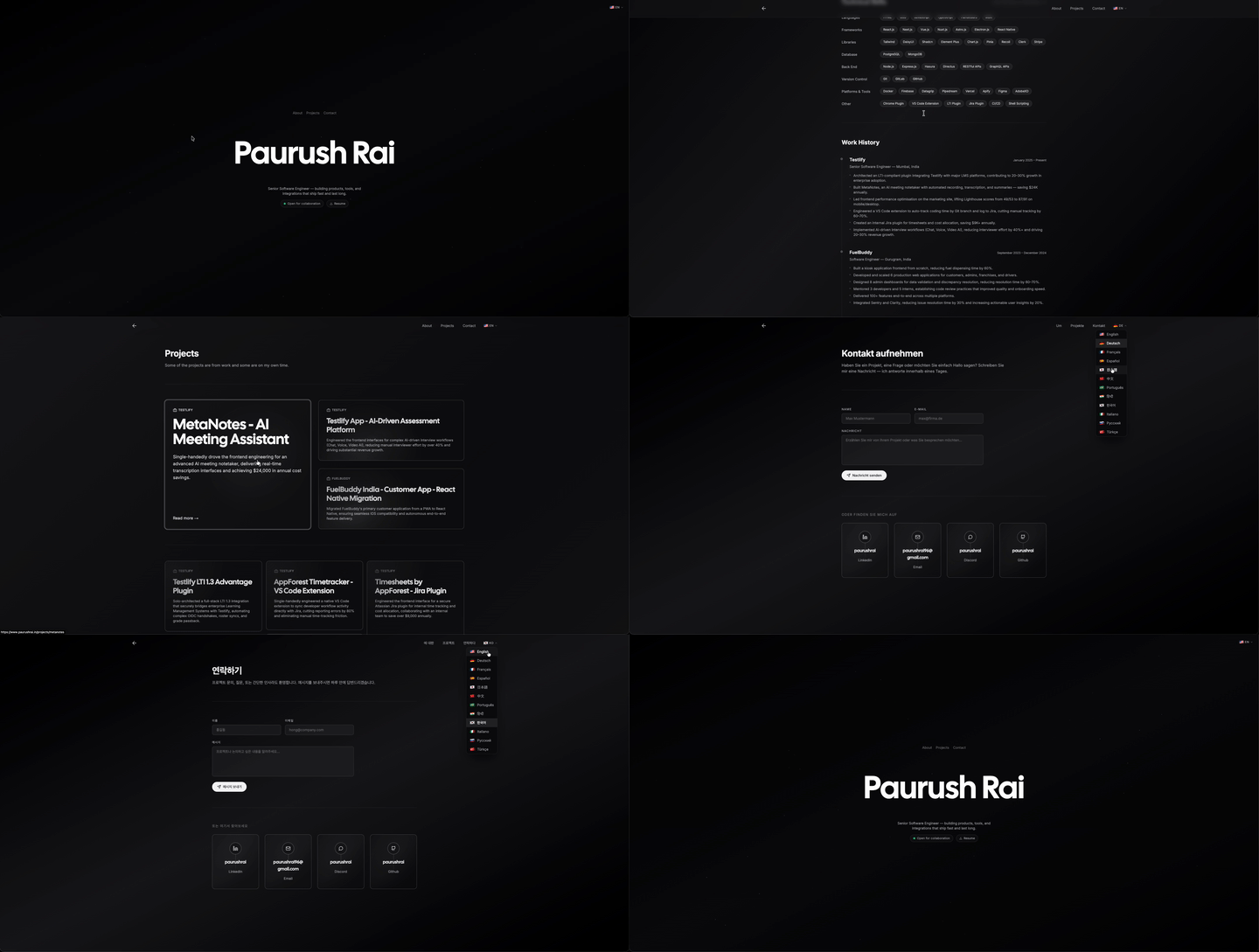
This portfolio is built with Next.js 16 App Router and maintained as an open-source product. The codebase is publicly accessible on GitHub with a 100/100 Lighthouse score for Performance, Accessibility, and SEO.
What is in it
- 12-language localization: Full support for English, German, Spanish, French, Hindi, Italian, Japanese, Korean, Portuguese, Russian, Turkish, and Chinese. Driven by a type-safe language context and translation dictionary, updating the HTML lang tag and canonical URLs dynamically for international SEO.
- Optimized canvas particle system: Interactive particle background drawn on HTML5 canvas. Cached coordinate calculations and lazy loading ensure 60fps animations without impacting initial page paint.
- First-party analytics proxy: Next.js rewrites route Umami's script and API calls through the same origin (
/um/*), so ad-blockers that target known third-party analytics domains don't strip it, with no custom serverless function to maintain. - Technical SEO and accessibility: Structured JSON-LD schema markup (Person, WebSite, SoftwareApplication, BlogPosting, BreadcrumbList), per-locale canonical and alternate links, automated OpenGraph cards, skip-to-content navigation, and full keyboard accessibility.
- Type-safe Contentlayer pipeline: Projects and blog posts are authored in localized MDX files, validated at build time, and statically rendered for fast performance.
Why it mattered
The site serves as a live, verifiable demonstration of engineering standards: strict TypeScript typing, comprehensive multi-language support, web performance optimization, and accessible UI design.
Built Solo, Still Evolving
I'm the only person who has ever committed to this repo, 188 commits since March 2026. It doesn't have a single ship date; it's a living site I keep iterating on as I add projects, fix bugs, and refine the UI, this exact case study included.
A Live CSP Bug, Found by Actually Running Lighthouse
Rather than assert a Lighthouse score, I ran a fresh audit against a production build. Best Practices came back at 73/100, not from a minor nitpick but because Microsoft Clarity was failing to load entirely. The Content Security Policy allowlisted www.clarity.ms, but Clarity's script actually loads from scripts.clarity.ms and posts its analytics beacon to u.clarity.ms, neither of which was allowlisted. Adding each subdomain as Chrome reported the next violation would have been a losing game, so the CSP entry became a https://*.clarity.ms wildcard instead, fixing script loading and beacon delivery in one change.
Why Best Practices Still Isn't 100
After the fix, Best Practices sits at 77, and closing that gap further isn't worth it. The remaining loss is entirely Microsoft Clarity's own third-party cookies, used for its cross-site ad-conversion sync with Bing. Dropping Clarity would close the gap, but it would also drop the session replays and heatmaps it provides. Keeping it is a deliberate tradeoff, not a blind spot.
Analytics Proxy Is Config, Not Code
The site's own copy used to describe this as a "custom serverless proxy." It isn't: it's two rewrites() entries in next.config.mjs mapping /um/script.js and /um/api/send to Umami's real hosts. Requests look same-origin to the browser, so ad-blockers that target known third-party analytics domains leave them alone, and there's no server code to maintain. Boring on purpose: a declarative platform feature does the whole job.
Translation Type Safety, Enforced at Compile Time
12 locale files, roughly 400 lines each, all typed against the shape of en.ts's inferred Locale type. A locale file missing a key en.ts has, or carrying an extra one, fails tsc. A missing translation is a build error caught before deploy, not a blank string a visitor finds first.
Data Model & Scale
- Content (projects, blog posts) is authored as per-locale MDX files, validated and statically generated at build time by Contentlayer2; the current build produces 288 generated documents and statically renders 200+ localized project and blog pages.
- The translation dictionary is 12 locale files, type-checked against one shared shape, not a runtime-loaded JSON blob per locale.
- The contact form's rate limiter is in-memory, per serverless instance: 5 requests per 10 minutes per IP, added after a self-audit found the endpoint had a spam honeypot and nothing else. It doesn't share state across cold starts or multiple instances; a distributed store (Netlify Blobs, Redis) would be the next step if abuse ever got coordinated faster than a single instance sees it.
These are the two things I'd revisit first if traffic or abuse patterns grew past what a single-instance, in-memory model can absorb. Known tradeoffs, not blind spots.
Build vs. Buy
No i18n framework (next-intl, next-i18next): locale is a dynamic route segment ([locale]) plus a React context, with the default locale left unprefixed at the root instead of forcing every URL through /en/. No headless CMS: content is MDX in the repo itself, versioned with the code that renders it, validated at build time by Contentlayer2 instead of trusted at runtime.
Stack
Next.js 16 / React 19 App Router, TypeScript, Tailwind CSS 4, Contentlayer2 for the MDX pipeline, Biome for lint and format, Vitest for tests, Framer Motion for UI animation, Resend for the contact form, Umami and Microsoft Clarity for privacy-respecting analytics, deployed on Netlify.